Understanding land
Top 5 Factors to Evaluate When Buying Land in Texas
Buying Land in Texas
Todd SchweberNovember 25, 2026 6 min read
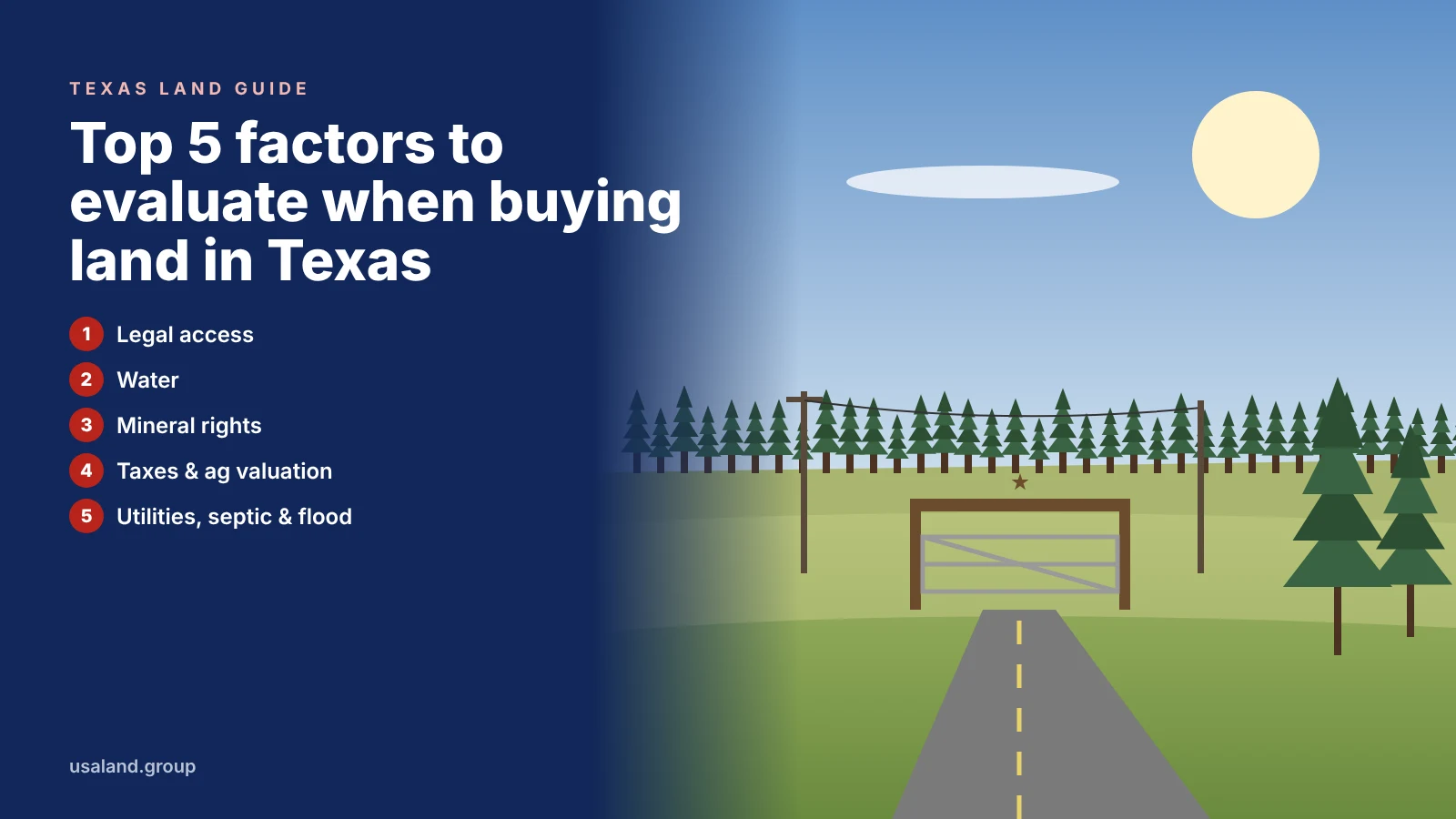
The five factors that matter most when buying land in Texas are legal access, water, mineral rights, property taxes and ag valuation, and utilities with septic and flood risk. Get those five right and almost any tract can work. Miss one and a cheap parcel can turn into an expensive problem.
Texas is different from most states. Counties generally have no zoning, groundwater follows its own rules, and minerals are often owned by someone else. Here is what to check, and why each one matters here in particular.
1. Legal access: can you actually get to the land?
Before anything else, confirm the land touches a public road or has a recorded, written easement. Many rural Texas tracts were split off decades ago with no road frontage, and a handshake agreement with a neighbour is not legal access. Without it, you may not be able to get a mortgage, title insurance or a building permit.
Ask for a current survey and read the title commitment. Both will show road frontage and any recorded easements. Paved county-road frontage is the gold standard; it also makes power and water easier to bring in.
2. Water: where will it come from?
In rural Texas, water comes from one of three places: a rural water supply corporation line, a private well, or hauled water with a storage tank. A water line at the road is the easiest and often the cheapest option over time.
If you need a well, ask neighbours how deep their wells are and check with the local groundwater conservation district. Texas follows the rule of capture, so you can generally pump the groundwater under your land, but many districts set spacing and permit rules. Rivers and most surface water belong to the state, so a creek on the property does not automatically give you a right to use it.
3. Mineral: rights who owns what is underneath?
In Texas, the mineral rights are often owned separately from the surface, and many tracts were sold "surface only" years ago. That matters because the mineral owner's rights generally come first: they can usually access the land to drill, as long as they reasonably accommodate the surface owner's existing use.
Read the title commitment for any mineral reservation. If the minerals are already severed, factor that into the price. In areas with little drilling it may never matter; in active oil and gas counties it can affect where you build.
4. Property taxes and ag valuation: what will it cost to hold?
Texas has no state income tax, but property taxes are among the highest in the country, often 1.5 to 2.5 percent of appraised value depending on the county, school district and other local taxes. On rural land, the number that changes everything is agricultural or timber valuation, usually called an "ag exemption".
With ag valuation, the county taxes land on what it produces, not what it would sell for, which can cut the bill dramatically. If you buy land with ag valuation and stop using it for agriculture or timber, the appraisal district can charge a rollback tax for the past three years plus interest. Ask the seller for the current tax bill, whether the land is under ag valuation, and what use keeps it qualified.
5. Utilities, septic and flooding can you build where you want?
Check three things: power at the road, a workable septic site and the flood map. Electric co-ops serve most of rural Texas, and a line extension of more than a few hundred feet can cost thousands. Septic in Texas is regulated as an on-site sewage facility; many East Texas soils need an aerobic system, which costs more and requires a maintenance contract.
Then look up the parcel on the FEMA flood map. Low ground near creeks and rivers can flood in heavy rain, and building in a floodplain adds permits and insurance cost. Because most Texas counties have no zoning, also read any deed restrictions on the tract: they, not the county, usually decide what you can build.
A quick Texas land checklist
• Public road frontage or a recorded easement
• A water source you have priced: line, well or hauled
• Who owns the minerals, from the title commitment
• The current tax bill and ag valuation status
• Power at the road, a septic site and the flood zone
• Any deed restrictions or HOA
Where to start
The easiest way to avoid surprises is to buy land where these checks have already been done. At USA Land Group we survey every tract, confirm access and utilities, and list the price before you ask. Our current Texas land is in Camp County in Northeast Texas, about two hours east of Dallas, with paved road frontage, power and county water. You can see our land for sale in Texas and join the early list for new tracts.
If you are on the other side and own Texas land you no longer need, we buy that too. Sell your land in Texas directly to us, with no commission and closing costs paid. And if you are buying with the proceeds of a property sale, land can also work as 1031 exchange replacement property.
General information, not legal or tax advice. Talk to a Texas real estate attorney or tax professional about a specific purchase.
Frequently asked questions
What should I look for when buying land in Texas?
Check five things: legal access to a public road, a water source, who owns the mineral rights, the property taxes and ag valuation status, and whether power, a septic site and the flood zone allow you to build where you want.
Does Texas have zoning on rural land?
Generally no. Most Texas counties have little or no authority to zone rural land, so deed restrictions, HOA rules and county permits for septic and floodplain usually decide what you can build.
Do I get the mineral rights when I buy land in Texas?
Not always. Minerals are often owned separately from the surface in Texas. The title commitment shows whether a previous owner reserved them, and the mineral owner generally has the right to access the land to develop them.
What is a rollback tax in Texas?
A rollback tax is charged when land with agricultural or timber valuation stops qualifying. The appraisal district bills the difference between the lower ag-value tax and full market-value tax for the past three years, plus interest.
Can I drill a well on land I buy in Texas?
Usually yes. Texas follows the rule of capture for groundwater, but many areas have a groundwater conservation district that sets well spacing and permit rules. Ask neighbours how deep their wells are before you buy.
Can I buy land in Texas without a realtor?
Yes. Texas does not require an agent to buy land. You agree terms with the owner and close through a Texas title company, which handles the title search, title policy and recording.